
INVOCING & ACCOUNTS RECEIVABLE
Getting Paid Faster and Chasing Money Less
At Digital Cloud Services, we specialize in delivering efficient Invoicing & Accounts Receivable solutions that help businesses optimize their financial operations. Our services include automated invoicing, payment monitoring, receivable tracking, customer account management, and collection support, enabling organizations to improve cash flow, reduce outstanding balances, and strengthen financial performance.
Request a INVOCING & ACCOUNTS RECEIVABLE Assessment
What Do Invoicing and Accounts Receivable Management Actually Cover?
Invoicing and accounts receivable management is the process of generating accurate client invoices, tracking outstanding payments, and systematically collecting on overdue accounts.
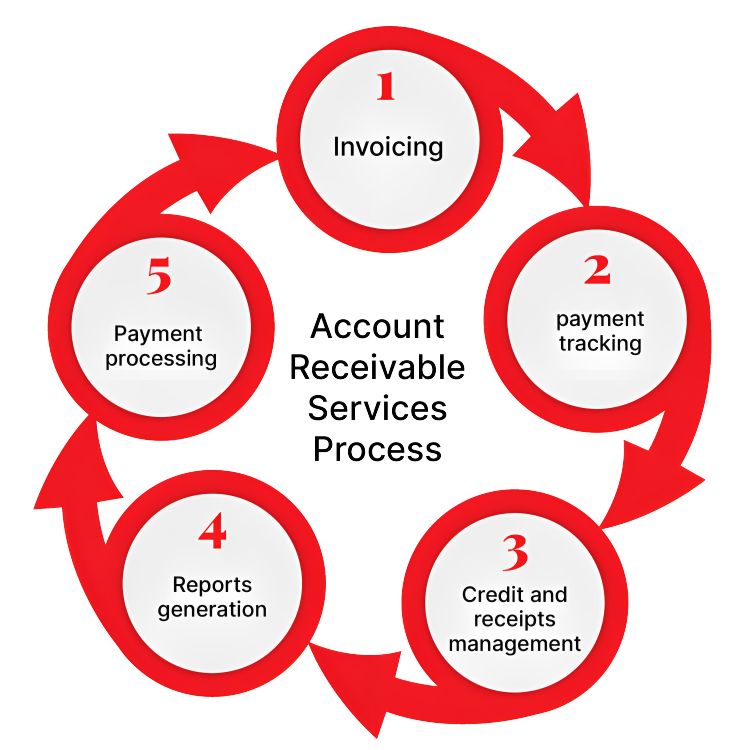
It starts the moment a product ships or a service is delivered—generating an invoice with correct line items, agreed pricing, and clearly stated payment terms—and continues through tracking whether that invoice gets paid on time, sending reminders as due dates approach or pass, and escalating collections efforts on accounts that go seriously overdue.
The accounts receivable side is really a monitoring and follow-up discipline layered on top of invoicing itself: every unpaid invoice sits in an aging report bucketed by how overdue it is, and a well-run process treats a 15-day-late invoice very differently from a 90-day-late one.
What we've consistently observed working with client cash flow is that businesses without a structured AR process don't lack revenue, they lack the systematic follow-up that turns earned revenue into collected cash on a predictable schedule.
The Core Components of an Invoicing & AR System
An invoice generation process creates accurate, itemized billing documents at the point of sale or service delivery, because errors at this stage, wrong pricing, missing line items, unclear terms are one of the most common legitimate reasons clients cite for delaying payment. This generation step comes first, since every downstream collections effort depends on the original invoice being correct and clearly understood by the client receiving it.
| AR Component | Function | What "Well-Managed" Looks Like |
|---|---|---|
| Invoice Generation | Creates accurate, clear billing documents | Correct line items, stated terms, professional presentation |
| Payment Terms & Enforcement | Sets and upholds expectations for timing | Clearly communicated net terms, consistent application |
| Aging Report Tracking | Categorizes outstanding invoices by overdue duration | Real-time visibility into current/30/60/90+ day buckets |
| Automated Reminders | Prompts payment before and after due dates | Scheduled reminders reducing manual follow-up work |
| Collections Escalation | Structured process for seriously overdue accounts | Defined escalation steps before write-off or collections agency |
| Cash Flow Forecasting | Projects incoming cash based on AR data | Forecasts that account for realistic, not optimistic, payment timing |
Why Do Late Payments Happen Even With Clear Invoices?
Late payments often happen due to client cash flow issues, internal approval delays on the client's end, or simply invoices getting lost in a low-priority queue rather than any dispute over the amount owed. This is an important distinction, because the appropriate response differs depending on the actual cause—a client with a genuine cash flow problem may need a payment plan conversation, while an invoice sitting unpaid due to an internal approval bottleneck usually just needs a well-timed reminder to the right contact.
Client Cash Flow
Measures financial timing. Working through liquidity cycles or temporary operational funding gaps.
Approval Bottlenecks
Measures internal processing. Navigating multi-tier sign-offs and vendor accounting queues.
Visibility Gaps
Measures tracking oversight. Preventing invoices from getting lost or buried in unmonitored inboxes.
Accounts Receivable Insights
Understanding how to manage aging reports and payment timelines is essential for maintaining predictable cash flow.
How Aging Reports Turn Reactive Collections Into a Proactive Process
This proactive frame is the core difference between businesses that chase money constantly and businesses that rarely have to—the second group isn't collecting more aggressively, they're simply intervening at the 30-day mark instead of the 90-day mark, when a light reminder is usually all that's needed instead of a difficult collections conversation.
At What Point Should an Overdue Invoice Be Escalated to Collections?
Escalating too early risks souring an otherwise good client relationship over what might just be a slow internal approval process, while waiting too long past 90 days significantly reduces the actual likelihood of ever collecting the full amount, since recoverability drops sharply the longer an invoice sits unpaid.

Invoicing & AR Needs Differ by Business Model
Each model uses the same underlying invoicing and collections discipline, but the specific workflow—milestone tracking, recurring billing recovery, or PO matching—has to fit how that business actually gets paid.
Project-Based Services
A project-based service business typically invoices in milestones tied to deliverables, which means its AR process needs to track partial payments and remaining balances per project rather than a single flat invoice.
Subscription & Recurring
A subscription or recurring-revenue business needs an AR system built around automated recurring billing and failed-payment recovery, because the primary receivables risk is a declined card or expired payment method rather than a client actively disputing an amount owed.
B2B Corporate Invoicing
A B2B business invoicing large corporate clients on net-30 or net-60 terms needs a more formal AR process built around purchase order matching and multi-contact follow-up, because corporate payment approval often routes through several people before a check is actually cut.
Manual Invoicing vs. Managed Invoicing & AR Services
Does Outsourcing Invoicing and Collections Actually Improve Cash Flow?
Yes, a structured, consistently followed AR process typically reduces average days-sales-outstanding compared to ad hoc, manually managed invoicing. When invoicing and follow-up happen on a defined schedule rather than whenever a business owner finds time, overdue invoices get caught and addressed earlier, which directly shortens the average time between delivering work and actually collecting payment for it.
This isn't just a convenience improvement; for many businesses, the gap between earned revenue and collected cash is the single biggest constraint on being able to take on new work or cover payroll. Tightening that gap has a direct, measurable effect on available working capital.
What to Look for in an Invoicing & AR Management Provider
-
Clear escalation protocol — ask exactly what happens at each stage of an overdue invoice.
-
Integration with existing accounting software — confirm compatibility before switching systems.
-
Realistic aging reporting — request sample reports to see how visibility is actually presented.
-
Client-relationship-aware collections tone — clarify how they balance firmness with maintaining the relationship.
-
Cash flow forecasting capability — check whether AR data feeds into broader financial projections, not just a standalone report.
Ready to Stop Chasing Payments Yourself?
Send us a snapshot of your current invoicing setup and outstanding balances, and we'll show you exactly where the gaps are and what a properly managed AR process would recover for your cash flow.
Get In Touch