
Payroll Management
Accurate, On-Time Pay Without the Compliance Risk
A single missed tax withholding or late pay run doesn't just frustrate employees, it exposes a business to penalties that compound fast. Payroll management replaces manual, error-prone pay processing with a structured system that calculates, files, and pays correctly, every cycle, without the business owner carrying that compliance risk alone.
Request a Payroll Assessment
What Does Payroll Management Actually Involve?
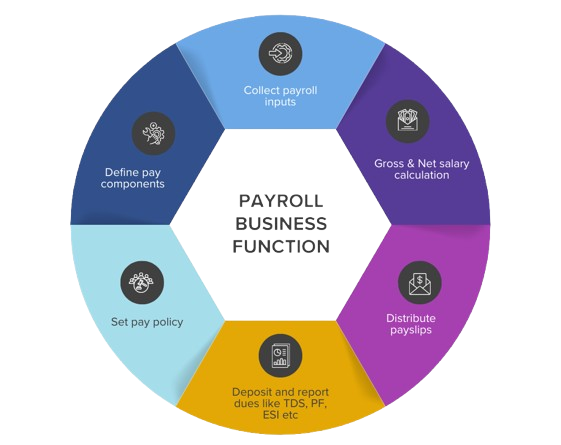
Payroll management is the end-to-end process of calculating employee wages, withholding and remitting the correct taxes, and maintaining compliant records for every pay cycle. It starts with gathering hours, salary rates, and any bonuses or commissions for the pay period, then applies the correct tax withholdings, benefits deductions, and garnishments based on each employee’s specific situation and jurisdiction.
From there, net pay is disbursed via direct deposit or check, while the withheld taxes are deposited with the appropriate federal, state, and local authorities on their required schedules and every one of these steps needs to be documented in a way that holds up if a labor or tax authority ever requests records.
What we’ve consistently seen in businesses that manage payroll manually in-house is that the process looks straightforward until a business scales past a handful of employees, at which point the compounding complexity of tax jurisdictions, deduction types, and filing deadlines turns a routine task into a significant liability if even one step slips.

The Core Components of a Payroll Management Service
A gross-to-net calculation engine converts each employee's hours or salary, along with applicable overtime, bonuses, and commissions, into an accurate net pay figure before a single deduction is applied. This calculation sits at the center of the entire payroll process, because every downstream tax withholding, benefits deduction, and filing obligation is derived directly from getting this number right in the first place.
| Payroll Component | Function | What "Well-Managed" Looks Like |
|---|---|---|
| Gross-to-Net Calculation | Converts hours/salary into accurate net pay | Correct overtime, bonus, and commission handling |
| Tax Withholding & Remittance | Calculates and deposits required tax amounts | On-time federal/state/local deposits, zero penalty notices |
| Employee Classification | Determines correct tax and benefits treatment | Accurate employee vs. independent contractor status |
| Benefits & Deduction Management | Applies healthcare, retirement, garnishment deductions | Deductions matched precisely to plan and legal requirements |
| Direct Deposit & Disbursement | Delivers pay on schedule | Consistent on-time payday, minimal payment errors |
| Compliance Reporting | Documents payroll for audits and filings | Audit-ready records, accurate year-end tax forms |
Why Does Employee Misclassification Create Such a Significant Risk?
Misclassifying an employee as an independent contractor shifts tax withholding, benefits eligibility, and labor protections in ways that create direct liability for back taxes and penalties if discovered.
This classification frame matters because the distinction isn’t a paperwork formality—it determines who’s legally responsible for withholding income tax, who pays employer-side payroll taxes, and whether the worker is entitled to benefits like overtime and unemployment insurance.
In our experience reviewing payroll setups for growing businesses, misclassification most often happens unintentionally, when a business brings on what functions as a regular employee under a contractor label for simplicity, without realizing that labor authorities evaluate the actual working relationship, control, schedule, and tools provided rather than just the label on the contract.
How Payroll Management Handles Multi-Jurisdiction Compliance
A business with employees working across multiple states or regions must apply different tax withholding rules, minimum wage requirements, and filing schedules for each jurisdiction simultaneously, because payroll compliance obligations are set locally, not uniformly at a national level.
This becomes particularly complex for remote-first businesses, where an employee working from a different state than the company’s registered location can trigger tax registration and withholding obligations in that employee’s actual state of residence.
A well-run payroll management service tracks these jurisdiction-specific rules automatically as employees are onboarded, rather than relying on a business owner to manually research and apply the correct rules for every new hire’s location—a step that’s easy to miss and expensive to get wrong retroactively.
How Often Does Payroll Tax Compliance Actually Change?
Payroll tax rates, thresholds, and reporting requirements change at least annually, and often more frequently at the state and local level.
Federal tax brackets, Social Security wage bases, and minimum wage rates are typically adjusted on an annual cycle, but state and local jurisdictions frequently introduce mid-year changes to minimum wage, paid leave mandates, or withholding tables that a business running payroll manually can easily miss.
This is exactly why ongoing payroll management rather than a one-time setup matters: compliance isn’t a static configuration you set once, it’s a continuously moving target that has to be monitored and updated every cycle.
Payroll Needs Differ by Business Size and Structure
A small business with a handful of hourly employees needs straightforward gross-to-net calculation, on-time tax deposits, and simple direct deposit disbursement, because its complexity is low but the compliance risk of a missed deadline is exactly the same as a larger company’s. A mid-sized business with a mix of salaried, hourly, and commissioned staff needs more sophisticated handling of overtime rules, bonus structuring, and benefits deductions, because the variety of pay structures multiplies the number of ways a calculation can go wrong. A multi-state or multi-entity business needs payroll management capable of tracking distinct tax jurisdictions and filing schedules for each location simultaneously, because a single missed state registration can trigger penalties that dwarf the cost of the payroll service itself. The underlying payroll discipline is identical across all three, but the complexity of classification rules, jurisdictional tracking, and deduction handling scales directly with how the workforce is structured.
In-House Payroll vs. Outsourced Payroll Management
Is Outsourcing Payroll Actually More Cost-Effective Than Managing It In-House?
Yes, outsourced payroll management is typically less expensive than the combined cost of in-house staff time, payroll software licensing, and the financial risk of compliance errors. Running payroll internally requires either a dedicated staff member's time each cycle or a business owner personally absorbing that workload, plus the cost of software and the ongoing burden of tracking constantly changing tax rules across every applicable jurisdiction.
What to Look for in a Payroll Management Provider
- Multi-jurisdiction expertise — confirm they handle every state or region your employees actually work in
- Classification review — ask whether they audit existing worker classifications, not just process what's given to them
- On-time deposit track record — request evidence of consistent, penalty-free filing history
- Integration with existing HR/accounting tools — check compatibility before switching providers
- Transparent error correction process — clarify what happens, and who's liable, if a mistake occurs
Ready to Take Payroll Off Your Plate?
Don’Send us your current headcount, pay structure, and any states or regions your team works from, and we'll map out exactly what a properly managed payroll setup would look like for your business, no generic quote, just your actual numbers..
Get In Touch